
-
 CONGRÈS16 juin 2026
About
the event
eNeuroVasc, the congress bringing together healthcare professionals engaged in the fight against cerebrovascular accidents!
Cerebral infarctions, intracranial aneurysms, arteriovenous malformations… Cerebrovascular diseases are complex and a collective effort is required to combat them. The stakes are indeed high: strokes are currently the leading cause of female mortality, and the primary cause of acquired disabilities in adults.
During the acute phase, every minute matters. The quality of the treatment depends on a swift and well-coordinated response by all parties involved: first responders, emergency medical services, intensive care units specialising in cerebrovascular accidents, interventional neuroradiologists, neurosurgeons, rehabilitation physicians and other support teams… All these stakeholders are working towards the same goal: to reduce delays, improve the care pathway, and optimise the patient’s chances of making a full recovery.
eNeuroVasc was created in 2018 by the teams of the Adolphe de Rothschild Foundation Hospital to provide a regular event where healthcare professionals specialising in the field of cerebrovascular accidents could meet and share.
This year, eNeuroVasc has partnered with the NeuroVasc 2030 federation of university hospitals – a network of excellence funded by the AP-HP, the INSERM and Paris Cité University – to achieve this goal, by bolstering cooperation, promoting proper practices, encouraging innovation and research, and ultimately improving the quality of the healthcare provided.
Aspects and key points of the congress
- Venue for in-person attendance: Philharmonie de Paris (19th arrondissement)
- Free registration, courtesy of our partners
- Live streaming on internet and access replay
- Short and dynamic sessions, focusing on field experience
- Rich medical and scientific content
- A field-wide approach: exchanges, debates, cooperation and the creation of lasting relationships among different specialisations
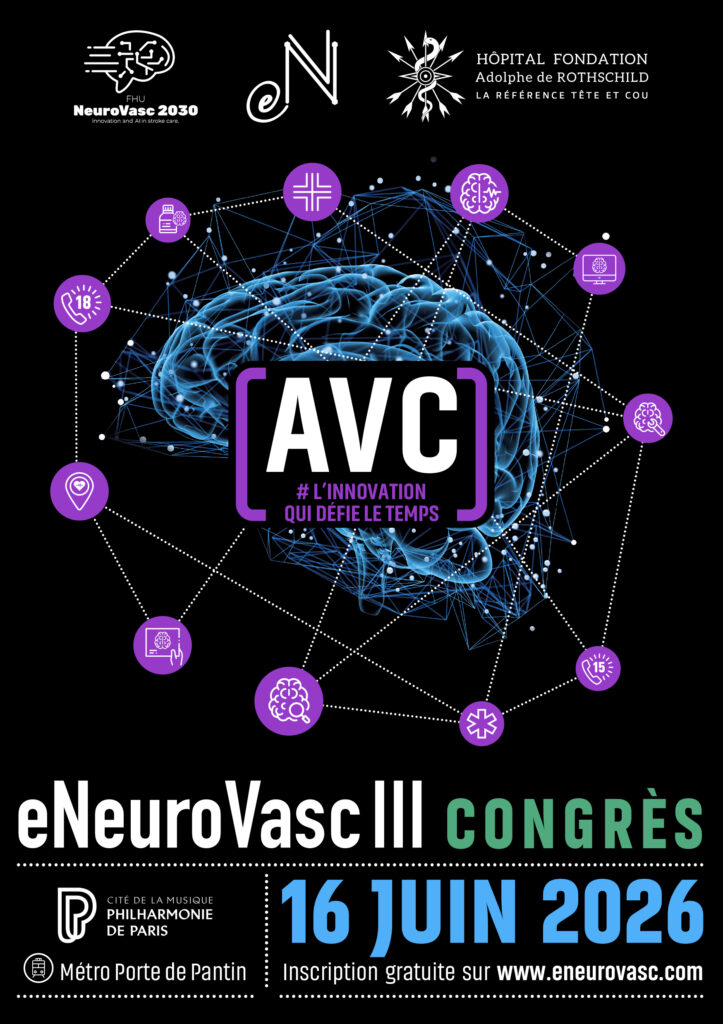
When
June 16, 2026
Where
Philharmonie de Paris
Paris, France
eNeuroVasc
eNeuroVasc
2026 Programme
Day
16 June 2026
09:00 - 09:15
Opening remarks
09:15 - 10:30
Earlier diagnosis for earlier treatment
09:15 AM – 09:30 AM | What is new in the scientific literature since eNeuroVasc II?
09:30 AM – 10:30 AM | Roundtable/Diagnostic biomarkers: news and perspectives
A .Imaging
• Advanced imaging in case of acute neurologic deficit < 24 hours
• AI-generated radiological biomarkers of cerebrovascular accidents
B. Biology
• Blood biomarkers and thrombi
10:30 - 11:00
Break
11:00 - 12:15
Reorganising to provide early treatment (Part 1)
11:00 AM – 11:15 AM What is new in the scientific literature since eNeuroVasc II?
11:15 AM – 12:15 PM Roundtable/Reorganising: new and perspectives
A. Reorganising the teamwork
• Door-in/door-out delays and care pathway monitoring tools
• Performing thrombolysis in under 20 minutes?
• Interhospital transfers and new recommendations by the SFMU/SFNV
12:15 - 13:30
Lunch
13:30 - 15:30
Reorganising to provide early treatment (Part 2)
B. Reorganising the imaging
• Straight to the INR operating room?
• In ambulances, at the doorstep of the patient’s home?
• What if we performed a CT scan?
C. Reorganising the territory
• New thrombectomy centres in the Île-de-France region?
• Training differently and together?
• AI-assisted medical opinions?
15:30 - 16:00
Break
16:00 - 17:00
Therapeutic innovations
04:00 PM – 04:20 PM | Ischemic stroke and technical innovations in the INR operating room
04:20 PM – 05:00 PM | What is new in terms of haemorrhagic strokes?
17:00 - 17:30
Closing remarks: So, what progress can we hope to achieve for the 4th edition of eNeuroVasc?
Meet
our committee
Scientific committee
- Prof. Frederic ADNET, Medical Emergency Services, Paris
- Prof. Sonia ALAMOWITCH, Neurology, Pitié-Salpêtrière University Hospital, Paris
- Dr. Alain AMERI, Neurology, Meaux Hospital, Seine-et-Marne
- Dr. Raphael BLANC, Interventional Neuroradiology, Adolphe de Rothschild Foundation Hospital, Paris
- Dr. Laurence NAHUM, Neurology, Robert Ballanger Intercommunal Hospital Centre, Aulnay-sous-Bois, Seine-Saint-Denis
- Dr. Jean-Michel DEVYS, Anaesthesia and Resuscitation, Adolphe de Rothschild Foundation Hospital, Paris
- Prof. Anne-Laure FERAL-PIERSSENS, Medical Emergency Services, Seine-Saint-Denis and Emergency Services, Avicenne Hospital, Bobigny, Seine-Saint-Denis
- Dr. Sabine GUINEMER, Medical Emergency Services, Seine-Saint-Denis and Emergency Services, Avicenne Hospital, Bobigny, Seine-Saint-Denis
- Dr. Carole HENRY, Neurology, Saint-Denis Hospital Centre, Saint-Denis, Seine-Saint-Denis
- Dr. Bertrand LAPERGUE, Neurology, Foch Hospital, Suresnes, Hauts-de-Seine
- Dr. Yann LHERMITTE, Neurology, Sud-Francilien Hospital Centre, Corbeil-Essonnes, Essone and Medical Emergency Services, Seine-et-Marne
- Prof. Mikael MAZIGHI, Neurology, Lariboisière Hospital, Paris
- Dr. Michael OBADIA, Neurology, Adolphe de Rothschild Foundation Hospital, Paris
- Dr. Michel PIOTIN, Interventional Neuroradiology, Adolphe de Rothschild Foundation Hospital, Paris
- Dr. Julien SAVATOVSKY, Medical Imaging, Adolphe de Rothschild Foundation Hospital, Paris
- Dr. Matthias WARGON, Emergency Services, Mobile Emergency and Resuscitation Service, Delafontaine Hospital, Saint-Denis, Seine-Saint-Denis
- Prof. Benjamin MAIER, Neurology, Paris-Saint Joseph Hospital Group, Paris
- Medical and paramedical teams of the Vascular Neurology and Interventional Neuroradiology departments of the Adolphe de Rothschild Foundation Hospital, Paris

- Dr. Vincent DOAT-SARFATI, NeuroVasc 2030 Federation of University Hospitals, Lariboisière Hospital, Paris
- Estelle DUBUS, Neurology, Lariboisière Hospital, Paris
- Prof. Matthieu HEIDET, Medical Emergency Services, Val-de-Marne, Henri Mondor Hospital, Créteil
- Prof. Éric JOUVENT, Neurology, Lariboisière Hospital, Paris
- Prof. Guillaume TURC, Neurology, Sainte Anne Hospital, Paris
Organisation committee
- Khadija BELLAHSSAN, Neurosciences, Adolphe de Rothschild Foundation Hospital, Paris
- Géraldine EDOUARD, Interventional Neuroradiology, Adolphe de Rothschild Foundation Hospital, Paris
- Perrine BOURSIN, Interventional Neuroradiology, Adolphe de Rothschild Foundation Hospital, Paris
- Estelle DUBUS, Neurology, Lariboisière Hospital, Paris
- Prof. Mikael MAZIGHI, Interventional Neuroradiology, Adolphe de Rothschild Foundation Hospital, Paris
- Dr. Hocine REDJEM, Interventional Neuroradiology, Adolphe de Rothschild Foundation Hospital, Paris
2018 & 2022 Replays
Les vidéos en Replay reviennent très prochainement.
To view the content,, create an account or log in.
Our partners



The venue
Cité de la musique - Philharmonie de Paris
221, Avenue Jean-Jaurès
75019 Paris
BY PUBLIC TRANSPORT
Metro
Line 5: Porte de Pantin station/see the metro map
Direct from Gare du Nord (5 stops) and from Gare de l’Est (6 stops).
Tram
T3b : Porte de Pantin station/See the itinerary
Bus
Line 75: Pont Neuf – Porte de Pantin/See the itinerary
Line 151: Bondy-Jouhaux-Blum – Porte de Pantin/See the itinerary
RER (Regional Express Network)
Line E: Pantin station, then take the bus 151 for a few stops to reach Philharmonie de Paris/See the itinerary
BY CAR
Philharmonie de Paris parking
Direct access from the Boulevard Périphérique and from Porte de Pantin to Philharmonie parking/Q-Park
185, Boulevard Sérurier, 75019 Paris – 564 parking spaces for cars, including 15 parking spaces for persons with reduced mobility, and 90 parking spaces for two-wheel vehicles.
Book your parking at the Philharmonie de Paris parking in advance (subject to parking space availability) in just a few clicks, in a fast and secure manner (up to 2 hours in advance), exclusively on q-park-resa.fr.
Use the parking’s south exit to access the lifts that take you up to the Pierre Boulez amphitheatre.